
How to Stop Old Patterns From Controlling Your Reactions
The first step isn't changing your behavior. It's understanding what you're actually reacting to.

The Call
I finally made it to Riyadh.

After all the hardship, all the setbacks, everything that had to happen to get us here — we were actually here.
And then, two days ago, my father called.
I don’t fully know why I picked up. He’d tried a few times before that, and I’d let it go on purpose.
Why This Phone Call Wasn't Just a Phone Call
For anyone who doesn’t know my history: my relationship with my father has never been simple. When I was ten and eleven, he hired someone to stalk and terrorize our family. He was emotionally abusive toward all of us and physically abusive toward my mother. He lied constantly. One night, he kidnapped my brother. I begged my mother to call the police, and we did. He returned the same night, but these were the years of hell with him. Years later he moved to Turkey and remarried, and the distance turned out to be one of the best things that ever happened to us.
So our relationship today is exactly what you’d imagine: distant, careful, mostly nothing.
But I answered the call.
“Hi, I’ve tried calling you a few times, but we keep missing each other,” he said.
“Yes, same here. And now we’re here in Riyadh.”
There was no excitement in his voice. No how is it. No how was the move. No how are the kids.
Instead, in a flat, sad tone: “I hope you’ll have a good time. Hopefully you’ll finally make it.”
I felt something start inside me.
Then: “So you really left Rome, huh?” He sounded almost surprised.
“Of course. You knew we were leaving Rome. That’s nothing new.”
“Yes, hopefully you’ll make it. I left for Turkey twenty years ago...”
And there it was. Within seconds, the conversation was about him.
For the next few minutes I listened to the story of his move to Turkey, how hard it had been, and then — somehow — Turkey and Saudi Arabia became comparable experiences. Which, if you know anything about either country, is a little like comparing Italy and Spain and deciding they’re basically the same because they’re both in Europe.
Eventually his own experience became the reason I, too, would be fine in Riyadh.
I started trying to end the call. He asked briefly about the kids, told me to give them a hug, and that was it.
Eight minutes. That’s how long it lasted.
And within seconds of hanging up, I felt rage. Anger, resentment, frustration, all at once.
I turned to my husband, who’d overheard the whole thing, and said, “Why did I even answer? He’s such an asshole.”
He looked at me, said “Yeah,” and hugged me. He has his own history with his mother, which is part of why we understand each other the way we do. Years of therapy on both sides taught us the same term for it: wounded narcissist. His mother. My father.
What Eight Minutes Used to Cost Me
What bothered me almost as much as the call itself was this: after all these years, after all the therapy, a few minutes with my father could still bring all of that back up in me.
The phone call lasted eight minutes. But in the past, what I did with those eight minutes could have lasted the entire day. I could have replayed the conversation. Built the case against him again. Explained to my husband for the tenth time why it upset me. And underneath all of it, slipped straight back into the same old feeling: he doesn’t see me.
That’s the part that gets me now. The event happens once. What we make it mean can keep happening inside us long after it’s over.
That’s where R.I.S.E. begins.
Why R.I.S.E. Starts With Recognition
I didn’t build R.I.S.E. because I figured out how to stop difficult things from affecting me. I’ve had trauma, rejection, financial fear, burnout, plans that fell apart completely. I still get triggered. The goal was never to become someone nothing touches.
The goal is to notice what’s happening inside you before an old experience gets to decide what happens next. With these tools, I don’t stay angry for hours anymore. Now it’s a couple of minutes.
That’s why R.I.S.E. begins with Recognize & Reframe. Before I can integrate anything through mindset and movement, before I can strengthen my relationship with myself, before I can build what my next chapter actually requires — I need to know what I’m carrying into it.
You can’t build differently from a pattern you can’t see.
Recognize: What Actually Happened
I’ll walk through my own example. You’ll have yours — this is just one of many.
The event
My father called. We spoke for eight minutes. He showed almost no curiosity about our move, our kids, our work, or what this transition had actually been like for us. That’s what happened.
The meaning
What did I make it mean? He doesn’t care about me. He doesn’t see me. Nothing I do will ever be enough for him.
Those aren’t the same thing as the event. They’re interpretations built over decades with this person. That doesn’t make them stupid, or imaginary, or even wrong. It means they’re meaning — not the event itself.
The belief
What belief does that meaning activate? I’m not worth listening to. Maybe if I explain more, accomplish more, prove more, I’ll finally be seen.
The behavior
And what do I do because I believe that? Explain more. Try harder. Reach for connection again. Expect something from someone who’s shown me, repeatedly, what he’s capable of giving. Replay the conversation. Stay angry. Try to prove I’m right.
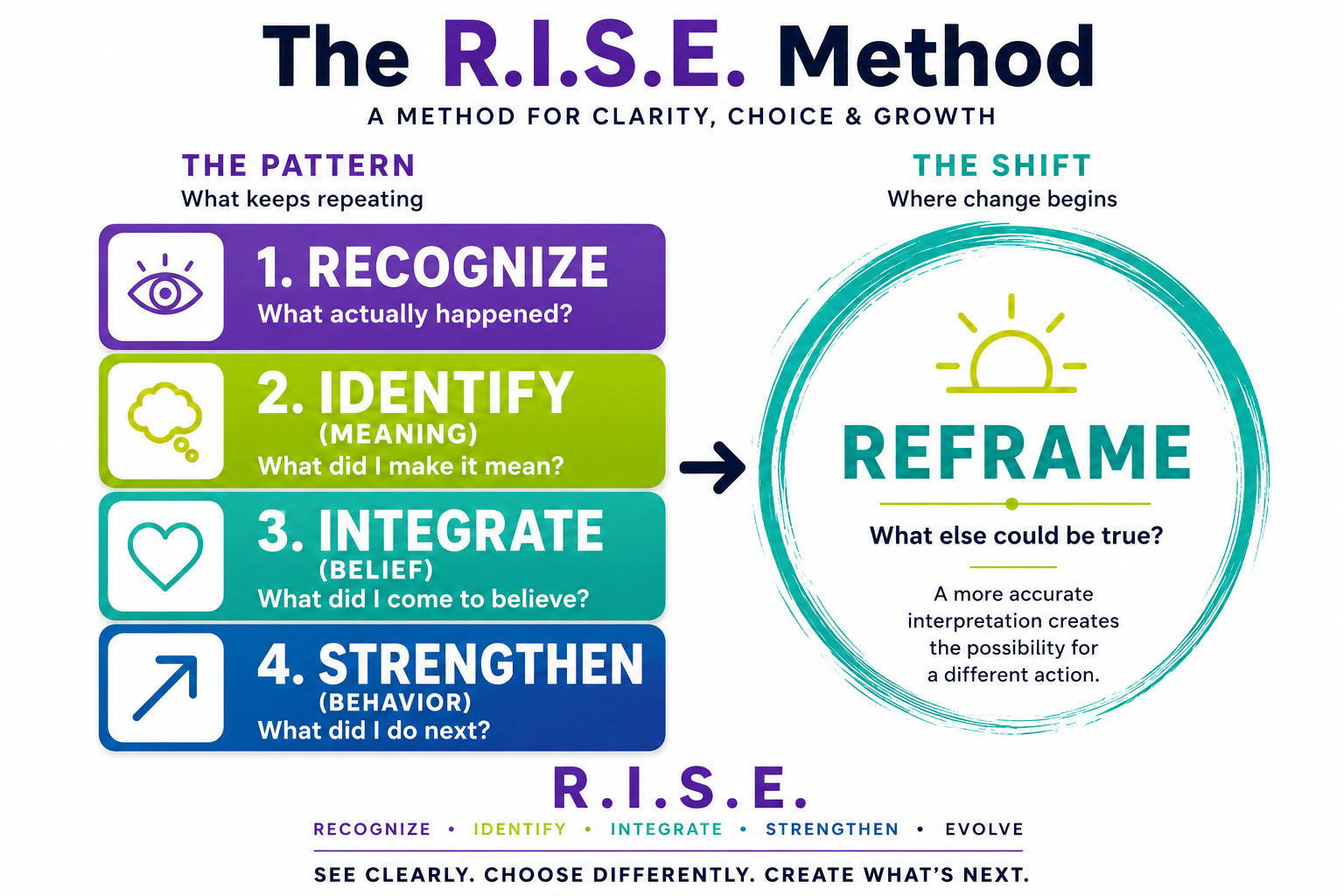
Event, meaning, belief, behavior. That’s the chain.
Reframe: What Else Could Be True?
Recognizing is the first step, but you can’t just sit in it. Reframing is what moves you. And reframing doesn’t mean telling yourself things like: my dad is wonderful, he really does care, that was actually a good conversation. None of that would feel true, and forcing it wouldn’t help.
A reframe doesn’t have to make the situation nicer. It has to make my interpretation more accurate. It doesn’t need to make you feel good — it needs to open up a different action than the one you’d take on autopilot.
So I asked myself: what else could be true?
For me, it was this: my father may simply not be capable of the emotional curiosity and connection I still sometimes expect from him. His inability to see me the way I wanted to be seen doesn’t say anything about whether I’m worth seeing. I don’t need to keep proving my life to someone who has never known how to witness it.
The event didn’t change. My father didn’t change, and he’s not going to. What changed is my relationship with myself — the position I take toward the event. Accept it, feel it, release it.
And from there, a different behavior becomes possible. Instead of prove, explain, rage, replay — maybe: accept, feel, release, continue with my day.
That’s Recognize & Reframe.
Maybe yours isn’t a father calling from Turkey. Maybe it’s your boss answering an email in two words. Your partner going quiet at dinner. Someone not inviting you. A client saying no. Checking your bank account and feeling your stomach drop. A friend who doesn’t text back.
The event may be happening today. The meaning you’re giving it may have been built years ago.
Now Try It With Your Own Story
A free exercise, if you want it:
Think of one thing that activated you this week. Ask yourself: what actually happened? What did I immediately make it mean? What did that meaning make me believe?
THE R.I.S.E. RECOGNIZE & REFRAME PRACTICE
Recognizing this while you’re calmly reading an article is one thing. Doing it while you’re angry, hurt, or overwhelmed is a different skill entirely.
This is a guided workbook that walks you through event, meaning, belief, behavior, and reframe — step by step. Available now for monthly, annual, and founding members.
Work through Recognize & Reframe → — LINK TO WORKBOOK PERK
Why This Has to Come First
Don’t stop here, though. There’s a reason R.I.S.E. starts with this step and not with action.
We usually want to jump straight to doing something — set the boundary, leave the relationship, start the business, build confidence, move forward. But if I haven’t recognized the belief underneath my behavior, I can take every one of those new skills and put them in service of the same old pattern. I can learn to communicate better while still desperately needing approval. I can get excellent at networking while still believing every rejection is a verdict on my worth. I can work harder while still believing financial uncertainty means I’m failing. I can set a boundary while secretly believing I’m a bad person for having one.
New skills built on top of an unrecognized pattern can simply make us better at repeating it. That’s why Recognize & Reframe has to come first — because it’s where we ask what we’re actually responding to.
This isn’t just a coaching idea. Reappraisal — changing what a situation means to you rather than changing the situation itself — is one of the more studied tools in emotion regulation research, and it’s linked to better mood, higher life satisfaction, and stronger relationships in people who use it regularly. I didn’t invent the underlying tools. What I’ve done is put them together, in an order and a language that’s actually usable when your hands are shaking and you don’t have time to read a study.
Where R.I.S.E. Goes From Here
Recognize & Reframe — see what you’re carrying, and change your relationship to the story.
Integrate — work the new understanding through mindset and movement, because knowing something intellectually doesn’t automatically change how your body responds.
Strengthen — build the relationship with yourself and the capacity to respond differently.
Elevate — develop the skills your next chapter actually requires, and start living it.
Each step depends on the one before it. You can’t integrate what you haven’t recognized. You can’t strengthen something you still don’t understand. And trying to elevate while old patterns are still making your decisions just rebuilds the life you were trying to leave.
GO DEEPER: THE RECOGNIZE & REFRAME VIDEO
If you want more than the written practice, I recorded the first R.I.S.E. session on Recognize & Reframe — a completely different real example from my own life: a stretch of financial uncertainty when I’d put everything into the studio and had almost nothing left in the bank.
The situation was real. But without realizing it, I’d turned “there’s very little money in the bank” into “I’m failing.” That meaning changed how I worked, how I lived, what I let myself have, and what I could even imagine doing next.
In the video I break down exactly how I recognized that pattern, how I reframed it, and what changed because of it. Available to annual and founding members.
Go deeper with the R.I.S.E. video → — LINK TO ANNUAL VIDEO PERK
If you’re already a monthly member and want to go through the full R.I.S.E. process with me as the video library grows, annual membership unlocks the series. Annual is currently 30% off your first year → See Offer here
Back to the Phone Call
My father didn’t change because I recognized the pattern. He didn’t suddenly get curious about my life. The call didn’t become less frustrating. And recognizing what was happening didn’t erase forty years of history.
What changed was what I did with those eight minutes. I felt the anger. I saw what it touched. I stopped asking the conversation to give me something it was never going to give me. And I went on with my day.
Maybe that’s where the work actually begins. Not becoming impossible to trigger. Not rewriting the past.
Recognizing what you’re carrying forward — before it gets to decide what happens next.
This is such a helpful framework. Yesterday I had a moment I was triggered by my child’s response to something and I immediately got upset with myself for letting it get to me.
I thought “I know this isn’t about me, why am I still having this emotional response?”
It’s soothing to recognize that it’s a process to untangle, that the emotions will always be there, and that over time the response can shift. (Which it already has so giving myself credit for the work I’ve done on that!)
Looking forward to learning more about the Integration piece 💜
An 8 minute call sounds very quick but to someone else it could feel like an eternity. That's great you shifted your perspective and used your RISE steps. I always say change what you can and embrace or accept what you can't. In other words, we can't control other's actions but we can control our reaction to their actions. Thank you for your share!